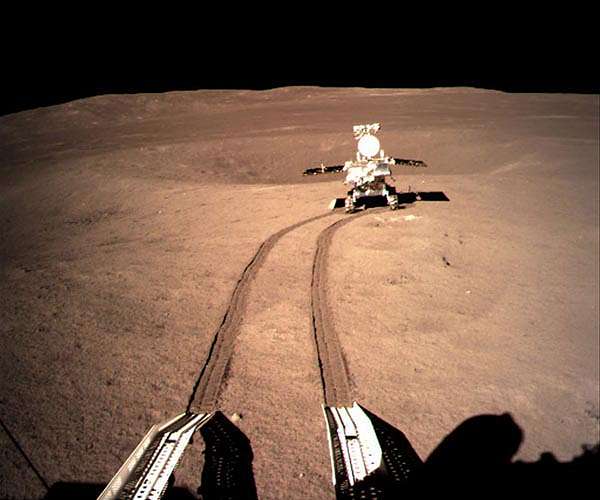
Apparently, China sees the Moon as a future source of fuel for terrestrial power and space dominance. At the moment Chinese nuclear scientists are studying lunar surface material samples brought back by its Chang'e 5 lunar exploration mission late last year. One sample is believed to contain helium-3, an isotope.
This particular isotope is very rare on Earth, but thought to be abundant in lunar surface material. Verification of the presence of helium-3 could be very important, because helium-3 is thought to be the ideal future fuel for fusion reactors.
In fact, over the past few decades lunar helium-3 has been cited as a major reason to return to the Moon. However, little research has been conducted on the complete potential of lunar helium-3 mining.
One study, complete about seven years ago, of an end-to-end process for mining and delivering helium-3 to terrestrial reactors assumed a set of requirements for creating 10% of the global energy demand by 2040.
The assumed mission architecture included individual transportation elements such as Earth-to-LEO, LEO-to-lunar-orbit and lunar-orbit-to-lunar-surface. However, it was concluded that the most critical mission element was the lunar mining operation.
This study concluded that to supply 10% of the global energy demand by 2040, roughly 200 tons of Helium-3 would be required annually. To do this would require a regolith mining rate of about 630 tons per second. This number is based on an optimistic concentration of 20 ppb helium-3 in the lunar regolith. All this translates to a requirement of between 1,700 to 2,000 helium-3 mining vehicles.
Based on these numbers, the required power for mining operations would be as high as 39 GW, with a resulting power system mass of the order of 60,000 to 200,000 tons. To support the mining operation, a fleet of three lunar ascent/descent vehicles and 22 continuous-thrust orbit-transfer vehicles would be needed. And the expected annual costs are in the trillion-dollar range. Needless to say, this is one big idea that will require a BIG program.