
ENERGY TECH
Avoiding chains of magnetic islands may lead to fusion paradise
by Staff Writers
Washington DC (SPX) Jan 13, 2022

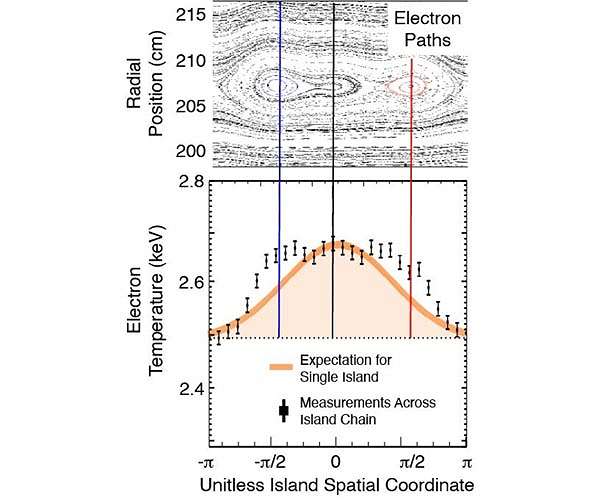
Top: plot of electron orbit paths based on reconstructed magnetic field geometry. Bottom: measured electron temperature across an island chain compared to the theoretical profile in the presence of a single island.

To create the conditions needed for fusion reactions, tokamak reactors contain a plasma in magnetic fields. These magnetic fields can contain tubular areas called magnetic islands. Plasma particles move extra quickly across these islands. This prevents the plasma from reaching the high temperatures necessary for fusion energy production. Fusion plants must therefore minimize the size of these regions.

For the first time, researchers have observed the spontaneous formation of a structure in the plasma with multiple magnetic islands. Known as "heteroclinic islands," they do not merge into each other while embedded in a larger magnetic field tube. These structures form areas of higher temperatures at each island center that are directly observed by local measurements.

Additional measurements of the magnetic field perturbation caused by these special island chains further confirm their existence in experiments and are consistent with simulation results.

Scientists can stabilize single magnetic islands by driving a current through their center. This stabilizing current effectively destroys the island. Destroying the island allows higher plasma densities and temperatures. In experiments, however, some islands persist even with a stabilizing current. The new observations of heteroclinic islands may explain why.

The discovery provides new information for theoretical models that predict the amount of current required to stabilize islands. This information will improve island models. These models will in turn lead to greater confidence in the current drive requirements for future magnetically confined fusion reactor designs. This could ultimately help engineers design more cost-effective reactors.

This work reports the first empirical observations of heteroclinic bifurcation in magnetic islands. Heteroclinic structures can form when magnetic islands with similar geometry and motion form without slipping past each other. Scientists use reconstructions of magnetic field structure to characterize the internal structure of the embedded islands.

Scientists derive input parameters for simulations and constrain those simulations from experimental data on the DIII-D National Fusion Facility tokamak. These data agree with the electron temperature profile derived from local data.

These measurements give a clear demonstration that heteroclinic bifurcation of magnetic islands can occur in tokamaks. This phenomenon can be crucial for avoiding island-related energy loss. The plasma current driving the island is split between heteroclinic center-points, and this phenomenon can now be added to theoretical models that describe the ways in which these islands can be stabilized to improve energy confinement.

Observing these island chains therefore improves researchers' understanding of plasma behavior in experiments, while also identifying the issues that must be resolved to create better designs for future magnetic fusion devices.

Research Report: "Experimental Observation of Magnetic Island Heteroclinic Bifurcation in Tokamaks"


Related Links
US Department of Energy
Powering The World in the 21st Century at Energy-Daily.com

ENERGY TECH
Common household cleaner can boost effort to harvest fusion energy on Earth
Plainsboro NJ (SPX) Jan 13, 2022
Scientists have found that adding a common household cleaning agent - the mineral boron contained in such cleaners as Borax - can vastly improve the ability of some fusion energy devices to contain the heat required to produce fusion reactions on Earth the way the sun and stars do. Physicists at the U.S. Department of Energy's (DOE) Princeton Plasma Physics Laboratory (PPPL) working with Japanese researchers, made the observation on the Large Helical Device (LHD) in Japan, a twisty magnetic facili ... read more

Comment using your Disqus, Facebook, Google or Twitter login.

Share this article via these popular social media networks
del.icio.usdel.icio.us DiggDigg RedditReddit GoogleGoogle

ENERGY TECH
Idaho researchers unveil enhanced electric power grid test bed

World risks more years of high energy prices, emissions: IEA

Dutch government sworn in with focus on climate

Lebanon mountain town warns of looming heating tragedy

ENERGY TECH
Avoiding chains of magnetic islands may lead to fusion paradise

Recycling already considered in the development of new battery materials

Molecular paddlewheels propel sodium ions through next-generation batteries

Chile awards two multi-million dollar lithium contracts

ENERGY TECH
Earth, wind and reindeer: Lapland herders see red over turbines

'Ocean battery' targets renewable energy dilemma

Share of German energy from renewables to fall in 2021

DLR starts cooperation with ENERCON

ENERGY TECH
Solar power, going down

Photon recycling - The key to high-efficiency perovskite solar cells

Standard Solar acquires 28.5 MW commercial solar project from True Green Capital Management

Ubiquitous Energy closes $30 Million Series B funding round

ENERGY TECH
Sweden probes drone flights over nuclear plants

Safety concerns raised for third French nuclear plant

France's EDF shares sink as production, price woes mount

France's new-generation nuclear plant delayed again

ENERGY TECH
Air France-KLM adds biofuel surcharge to plane tickets

From the oilfield to the lab: How a special microbe turns oil into gases

Estonia's wood pellet industry stokes controversy

Study shows how waste can be converted into materials for advanced industries

ENERGY TECH
Dutch climate activists target 29 firms after Shell win

Venezuela: the decline of an oil giant in crisis

Crude hits 7-year high on recovery hope but equity rally runs out

China, Iran begin implementation of sweeping strategic agreement

ENERGY TECH
Tied for 6th warmest year as 2021 shows continued trend

Last nine years all among 10 hottest-ever, says US

Last 7 years 'warmest on record' globally: EU

Six million need aid in drought-hit parts of Ethiopia: UN