Energy News  
An X-Ray Santa Claus In Orion

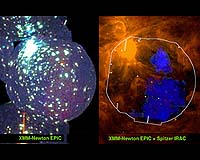
The images show the Orion nebula with its hot gas cloud. The left panel is an image obtained with XMM-Newton data from its European Photon Imaging Camera (EPIC) in X-rays. The right panel shows XMM-Newton data, compared to Spitzer observations of the same region. The Spitzer image is a composite image of data obtained in the infrared. Credits: Panel A: XMM-Newton EPIC (Guedel et al.), Panel B: AAAS/Science (ESA XMM-Newton and NASA Spitzer data)
by Staff Writers
Paris, France (ESA) Dec 03, 2007
Right in time for the festive season, ESA's XMM-Newton X-ray observatory has discovered a huge cloud of high-temperature gas resting in a spectacular nearby star-forming region, shaped somewhat like the silhouette of Santa Claus. An early present for astronomers, the cloud suggests that hot gas from many star-forming regions leaks into the interstellar medium.

The Orion nebula is the nearest dense star-forming region to Earth that contains stars much more massive than the Sun. XMM-Newton's newly-discovered gas cloud is composed of winds blowing from these high-mass stars that are heated to millions of degrees as they slam into the surrounding gas.

"There is one star in particular that dominates the nebula," says Manuel Gudel, Paul Scherrer Institut, Switzerland, who led the team that discovered the gas. The star in question is theta1 Orionis C, a giant star around 40 times mass of the Sun, with a surface temperature of 40,000C. Gudel and his colleagues think that the violent collision between the wind from this star and the surrounding dense gas is largely responsible for the newly-discovered hot gas cloud.

The high-temperature gas fills a region of the nebula that appears to be a huge cavity in optical and infrared images. The new observations, taken with XMM-Newton's European Photon Imaging Camera (EPIC) camera, suggest that astronomers are seeing only a particular portion of the gas. The X-rays from this portion escape absorption by patches of cold gas covering much of the front of the Orion nebula.

The surrounding pattern of absorbing clouds gives the detected gas its Santa Claus shape, with his prominent hat outlined by the northern gas bubble. In its entirety, the hot gas probably fills the whole nebula.

The team discovered it whilst conducting a survey of the young stars in the region. In the background of many of those images was a faint glow of X-rays. "The diffuse signal came up time and time again. Finally, we realized that it was something real," says Gudel.

The presence of the hot gas in a fairly common nebula like Orion is surprising. Although theory has predicted such hot gas clouds, previous observations suggested that a large number of massive stars shedding winds, or supernova explosions are required. These are found in some regions of vigorous high-mass star formation, which are scattered only rarely throughout the galaxy. The new observations show that much smaller collections of high mass stars can produce hot gas as well.

There are many star-forming regions similar to the Orion nebula throughout the galaxy, so there should be a network of channels and bubbles being filled up by the hot gas leaking from these various regions. "This is another possible way to enrich the interstellar medium. You don't have to wait for a sudden supernova to explode. You can do it with just one or two massive stars over millions of years," says Gudel.

The team now plans to obtain new observations to determine how the gas flows out of the Orion nebula. In particular, they want to see whether it connects with a giant bubble created by supernova explosions from previous generations of massive stars.
Community
Email This Article
Comment On This Article

Related Links
XMM-Newton overview
Stellar Chemistry, The Universe And All Within It


Memory Foam Mattress Review
Newsletters :: SpaceDaily :: SpaceWar :: TerraDaily :: Energy Daily
XML Feeds :: Space News :: Earth News :: War News :: Solar Energy News


NASA's GLAST Satellite Arrives At Naval Research Lab For Testing
Greenbelt MD (SPX) Nov 30, 2007
NASA's Gamma-ray Large Area Space Telescope (GLAST) has arrived at the Naval Research Laboratory (NRL) in Washington for its final round of testing. The GLAST spacecraft has successfully completed two of its three environmental tests at the prime contractor, General Dynamics Advanced Information Systems in Gilbert, Ariz. These tests included exposure to extreme vibrations and electromagnetic fields.


  • Moscow Finds Relief As Gas Prices Rise Only 30 Percent
  • Africa urged to avoid morning-after oil hangover
  • Tokyo wants gas exploration deal with China: official
  • Iraq Looks Inward To Rebuild Oil Industry

  • IAEA inspects Russian fuel for Iran: factory
  • French, Italian energy groups reach deal on nuclear cooperation
  • Seoul offers to use North Korean nuclear fuel rods: report
  • Two years to start Japan's giant nuke plant: expert

  • A Breathable Earth
  • Researchers Find Origin Of Breathable Atmosphere Half A Billion Years Ago
  • Study Reveals Lakes A Major Source Of Prehistoric Methane
  • Giant Atmospheric Waves Over Iowa

  • World's largest mangrove badly hit by cyclone: official
  • Indonesia's Papua scarred by vanishing forests
  • Reduce forest concessions, says Indonesian president: report
  • More than a billion trees planted in 2007: UN

  • Scientists to discuss ways to 'climate-proof' crops
  • Noah's Flood Kick-Started European Farming
  • Greenpeace slams 'unsustainable' new tuna quota
  • FAO report urges paying poor farmers to be green

  • US House to take up fuel efficiency standards after deal
  • NIST Measures Performance Of Auto Crash Warning Systems
  • German cars world champs, except in Germany
  • Honda Debuts All-New FCX Clarity Advanced Fuel Cell Vehicle

  • Announcement Of Opportunity For Sounding Rocket And Balloon Flights
  • China to order up to 150 Airbus jets during Sarkozy visit: report
  • Time Magazine Recognizes The X-48B
  • Virgin to offer carbon offsets alongside drinks and perfume

  • Nuclear Power In Space - Part 2
  • Outside View: Nuclear future in space
  • Nuclear Power In Space
  • Could NASA Get To Pluto Faster? Space Expert Says Yes - By Thinking Nuclear

  • The content herein, unless otherwise known to be public domain, are Copyright 1995-2007 - SpaceDaily.AFP and UPI Wire Stories are copyright Agence France-Presse and United Press International. ESA Portal Reports are copyright European Space Agency. All NASA sourced material is public domain. Additional copyrights may apply in whole or part to other bona fide parties. Advertising does not imply endorsement,agreement or approval of any opinions, statements or information provided by SpaceDaily on any Web page published or hosted by SpaceDaily. Privacy Statement