
ENERGY TECH
A safer, less expensive and fast charging aqueous battery
by Staff Writers
Houston TX (SPX) Jan 12, 2021

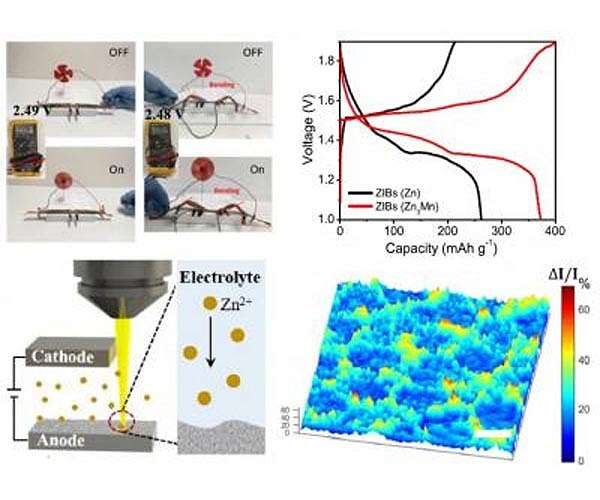
An electric fan (top left) is powered by the proposed zinc battery; typical charge/discharge profiles of ZIBs at 0.5C (top right); in-situ microscope setup to image the zinc deposition dynamics (bottom left); and the morphology change caused by the zinc deposition (bottom right).

Lithium-ion batteries are critical for modern life, from powering our laptops and cell phones to those new holiday toys. But there is a safety risk - the batteries can catch fire.

Zinc-based aqueous batteries avoid the fire hazard by using a water-based electrolyte instead of the conventional chemical solvent. However, uncontrolled dendrite growth limits their ability to provide the high performance and long life needed for practical applications.

Now researchers have reported in Nature Communications that a new 3D zinc-manganese nano-alloy anode has overcome the limitations, resulting in a stable, high-performance, dendrite-free aqueous battery using seawater as the electrolyte.

Xiaonan Shan, co-corresponding author for the work and an assistant professor of electrical and computer engineering at the University of Houston, said the discovery offers promise for energy storage and other applications, including electric vehicles.

"It provides a low-cost, high energy density, stable battery," he said. "It should be of use for reliable, rechargeable batteries."

Shan and UH PhD student Guangxia Feng also developed an in situ optical visualization technique, allowing them to directly observe the reaction dynamics on the anode in real time. "This platform provides us with the capability to directly image the electrode reaction dynamics in situ," Shan said. "This important information provides direct evidence and visualization of the reaction kinetics and helps us to understand phenomena that could not be easily accessed previously."

Testing determined that the novel 3D zinc-manganese nano alloy anode remained stable without degrading throughout 1,000 hours of charge/discharge cycling under high current density (80 mA/cm2).

The anode is the electrode which releases current from a battery, while electrolytes are the medium through which the ionic charge flows between the cathode and anode. Using seawater as the electrolyte rather than highly purified water offers another avenue for lowering battery cost.

Traditional anode materials used in aqueous batteries have been prone to dendrites, tiny growths that can cause the battery to lose power. Shan and his colleagues proposed and demonstrated a strategy to efficiently minimize and suppress dendrite formation in aqueous systems by controlling surface reaction thermodynamics with a zinc alloy and reaction kinetics by a three-dimensional structure.

Shan said researchers at UH and University of Central Florida are currently investigating other metal alloys, in addition to the zinc-manganese alloy.


Related Links
University Of Houston
Powering The World in the 21st Century at Energy-Daily.com

ENERGY TECH
Supercapacitors challenge batteries
Munich, Germany (SPX) Jan 05, 2021
A team working with Roland Fischer, Professor of Inorganic and Metal-Organic Chemistry at the Technical University Munich (TUM) has developed a highly efficient supercapacitor. The basis of the energy storage device is a novel, powerful and also sustainable graphene hybrid material that has comparable performance data to currently utilized batteries. Usually, energy storage is associated with batteries and accumulators that provide energy for electronic devices. However, in laptops, cameras, cellp ... read more

Comment using your Disqus, Facebook, Google or Twitter login.

Share this article via these popular social media networks
del.icio.usdel.icio.us DiggDigg RedditReddit GoogleGoogle

ENERGY TECH
China to launch carbon emissions trading scheme next month

Dozens of nations miss deadline to boost climate ambition

Germany rings in 2021 with CO2 tax, coal phase-out

2020 emissions: precedent-setting or bucking the trend?

ENERGY TECH
Supercapacitors challenge batteries

Transition metal 'cocktail' helps make brand new superconductors

First glimpse of polarons forming in a promising next-gen energy material

Bionic idea boosts lithium-ion extraction

ENERGY TECH
Deutsche WindGuard unlocks complex wind sites with ZX Lidars

Wind powers more than half of UK electricity for first time

ACWA Power signs three agreements for the first foreign investment based independent wind power project in Azerbaijan

Norway launches major wind power research centre

ENERGY TECH
New solar arrays to power International Space Station Research

Using solar energy and agriculture to limit climate change, assist rural communities

Impurities boost performance of organic solar cells

On the road to invisible solar panels

ENERGY TECH
Framatome to acquire Evopro nuclear and process automation business

Slovenia restarts nuclear plant after Croatia quake

Slovenia nuclear plant shut after Croatia earthquake

Ukraine to stop sending spent nuclear fuel to Russia

ENERGY TECH
Energy sorghum may combine best of annual, perennial bioenergy crops

Scientists develop a cheaper method that might help create fuels from plants

Turning trash into valuable chemical products and clean fuels

Fruity energy, spidery lenses: Nature-inspired solutions in 2020

ENERGY TECH
Second Australian charged over Iraqi oil bribes scandal

Venezuela's new taxi drivers: moonlighting soldiers

US leases long-sought Alaska oil rights in Trump's final days

Top global oil exporter Saudi Arabia launches car-free city

ENERGY TECH
Norway unveils new climate measures

Global warming to keep driving winds poleward, deep sea dust suggests

Human use has increased grasslands' contribution to climate change

GAO: Defense Dept. needs to better track climate change protections