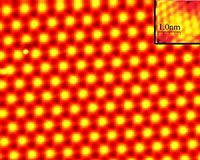
A superconducting sheet of lead only two atoms thick, the thinnest superconducting metal layer ever created, has been developed by physicists at The University of Texas at Austin.
Dr. Ken Shih and colleagues report the properties of their superconducting film in the June 5 issue of Science.
Superconductors are unique because they can maintain an electrical current indefinitely with no power source. They are used in MRI machines, particle accelerators, quantum interference devices and other applications.
The development of the thin superconducting sheets of lead lays the groundwork for future advancements in superconductor technologies.
"To be able to control this material-to shape it into new geometries-and explore what happens is very exciting," says Shih, the Jane and Roland Blumberg Professor in Physics. "My hope is that this superconductive surface will enable one to build devices and study new properties of superconductivity."
In superconductors, electrons move through the material together in pairs, called Cooper pairs.
One of the innovative properties of Shih's ultra-thin lead is that it confines the electrons to move in two dimensions, or one "quantum channel," like ballroom dancers gliding across the floor. Uniquely, the lead remains a good superconductor despite the constrained movement of the electrons through the metal.
Shih and his colleagues used advanced materials synthesis techniques to lay the two-atom thick sheet of lead atop a thin silicon surface. The lead sheets are highly uniform with no impurities.
"We can make this film, and it has perfect crystalline structure-more perfect than most thin films made of other materials," Shih says.
Share This Article With Planet Earth