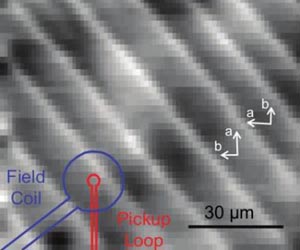
New images of iron-based superconductors are providing telltale clues to the origin of superconductivity in a class of ceramic materials known as pnictides. The images reveal that electrons responsible for the superconducting currents in some pnictides tend to flow primarily along the boundaries between the crystal grains that make up the superconductors.
The research, which is reported in a pair of papers appearing in the current issue of the journal Physical Review B, may help physicists to find new superconducting compounds that can carry current without the electrical resistance that plagues conventional metal conductors.
In order to identify the stripes that represent regions with dense superconducting currents, a group of Stanford University researchers measured the depth that magnetic fields penetrated into a superconducting sample.
When exposed to a magnetic field, currents in a superconductor flow in a way that creates a field inside the material that is the opposite of the applied field. When added together, the applied and internal fields cancel each other out inside the superconductor.
Essentially, it's as if the superconductor prevents a magnetic field from penetrating it (this is the source of the Meissner effect, which allows strong magnets to levitate over a superconductor). The better the superconductor, the more completely it can exclude a magnetic field.
By scanning an iron-pnictide superconductor with a probe that measures the depth that a magnetic field penetrates the material, the researchers could determine the regions where superconducting currents are strongest.
Unlike metal superconductors, which require temperatures close to absolute zero in order to operate, pnictides and many superconductors that function at higher temperatures (typically 10 to 135 degrees above absolute zero) are ceramics that are built of crystal grains.
Although the underlying mechanisms are not clear, measurements of magnetic field penetration indicate that superconducting currents flow best along the boundaries between the crystals.
In a Viewpoint appearing in the current edition of APS Physics, John Tranquada of Brookhaven National Laboratory points out that identifying the connection between crystal boundaries and superconductivity should help us to develop better high temperature superconductors.
Ultimately, superconductors operating closer to room temperature could help save energy by reducing the inefficiencies that comes with transporting electricity.
In addition, high temperature superconductors could be handy for creating powerful magnets for medical imaging and various industrial applications, as well as potentially leading to high speed computers and other novel electronic devices.
Share This Article With Planet Earth