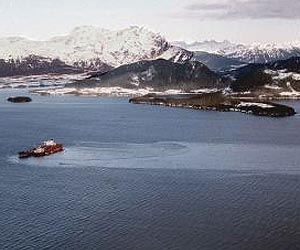
Traces of crude oil that linger on the shores of Alaska's Prince William Sound after the Exxon Valdez oil spill remain highly biodegradable, despite almost 20 years of weathering and decomposition, scientists are reporting in a new study.
Their findings, which appear in ACS' semi-monthly journal Environmental Science and Technology, suggest a simple approach for further cleaning up remaining traces of the Exxon Valdez spill – the largest in U.S. waters until the 2010 Deepwater Horizon episode.
Albert D. Venosa and colleagues note that bacteria, evaporation, sunlight, and other items in Mother's Nature's clean-up kit work together to break down the oil and make it disappear.
Scientists have known for years that adding nitrogen and phosphorus fertilizer to oil-contaminated soil can speed the growth of bacteria that decompose, or biodegrade, oil. But it has been uncertain whether oil that has lingered in the environment for almost 20 years still is biodegradable, leaving questions on whether further clean-up efforts might be worthwhile.
The scientists collected oil-contaminated soil from different beaches in Prince William Sound and treated the samples with phosphorus and nitrogen fertilizer in the presence of excess oxygen from the air.
Oil in the fertilized samples biodegraded up to twice as fast as oil in the unfertilized control samples, but significant biodegradation occurred even in the unfertilized controls.
The results showed that oxygen supply was the major bottleneck, or limiting factor, in the field that prevented further decomposition of the oil.
The scientists used data from the research to postulate a simple treatment scheme that would involve applying simple nitrate salts to possibly break down the natural organic matter in the sediment.
That would cause an increase in sediment porosity that would allow dissolved oxygen in seawater to penetrate to the oiled zone and create oxygen-rich conditions that might stimulate more rapid biodegradation.
Share This Article With Planet Earth