
ENERGY TECH
Revealing the mysteries of superconductors
by Staff Writers
Ames IA (SPX) May 10, 2018

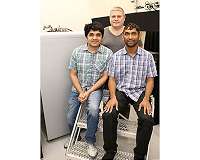
Kamal Joshi, Ruslan Prozorov, and Naufer Nusran.

The U.S. Department of Energy's Ames Laboratory has successfully demonstrated that a new type of optical magnetometer, the NV magnetoscope, can map a unique feature of superconductive materials that along with zero resistance defines the superconductivity itself. That unique feature is the Meissner effect, which is the expulsion of the magnetic field during a material's transition to a superconducting state.

"The Meissner effect is the hallmark signature of a true superconductor, which separates it from a hypothetical perfect metal with zero resistance," said Ruslan Prozorov, an Ames Laboratory physicist who is an expert in superconductivity and magnetism at low temperatures.

"That is fine in textbooks and in principle, but in real superconducting materials the Meissner effect is quite complicated. Robust screening of a magnetic field by a superconducting sample and Meissner expulsion upon cooling in a magnetic field can be confused. This effect is actually very weak and fragile and difficult to observe."

Until now, physicists have been able to observe the Meissner effect, but were unable to visualize its spatial distribution in the material and how that might vary between different superconducting compounds.

Now it is possible to map unique and distinguishing features of the Meissner effect, using a very sensitive magnetoscope that takes advantage of the quantum state of a particular kind of an atomic defect, called nitrogen-vacancy (NV) centers, in diamond.

While the science behind using NV centers as sensors has been known, scientists at Ames Laboratory wanted to know if the technology could be harnessed for probing magnetic fields with unprecedented sensitivity and good spatial resolution and apply it to studying various magnetic and superconducting materials.

"This technique, which is minimally invasive and extremely sensitive, is implemented in an optical device that operates successfully while samples are at the low temperatures (4 degrees above absolute zero), which is necessary for quantum materials exploration. This was no trivial undertaking," said Prozorov.

A member of Prozorov's group, Ames Laboratory scientist Naufer Nusran, led the development of this unique set-up, and current work used diamond film with NV-centers implanted right beneath the surface to measure larger-scale variation of the magnetic fields.

This is the first scientific paper published measuring the spatial distribution of the Meissner effect using an NV magnetoscope, proving that the technique works and is ready to be deployed to study even more complex problems.

Nusran also partnered with the Center for Nanoscale Materials, a DOE Office of Science user facility at Argonne National Laboratory, to design and fabricate the nanoscale pillars of diamond, each with a single NV center, for the construction of the magnetoscope, which took three years.

Deployment of these sensors, now housed in Ames Laboratory's ultra-low noise Sensitive Instrumentation Facility (SIF), is the next step in research for the Prozorov group in the new lab.

It's already led to some big surprises.

Iron-based superconductors, considered some of the most robust, showed practically none of that "hallmark" Meissner effect.

"This is a big puzzle and we have no explanation," said Prozorov. "It will be an exciting new avenue in research to understand why this happens."

The research is further discussed in the paper,"Spatially-resolved study of the Meissner effect in superconductors using NV-centers-in-diamond optical magnetometry," authored by N.M. Nusran, K. R. Joshi, K Cho, M. A. Tanatar, W.R. Meier, S. L. Bud'ko, P.C. Canfield, Y. Liu, T.A. Lograsso, and R. Prozorov; and published in the New Journal of Physics.


Related Links
Ames Laboratory
Powering The World in the 21st Century at Energy-Daily.com

ENERGY TECH
A novel voltage peak in the metal nanowire-superconductor hybrid structure
Beijing, China (SPX) May 03, 2018
Superconductivity, known as a quantum state with zero resistance and perfect diamagnetism, has attracted great attention in physical science. Due to the quantum size effect, low dimensional superconducting systems can exhibit novel behaviors different from bulk situation. Particularly, the investigations on strong spin-orbit coupling or ferromagnetic nanowires with superconducting contacts have become a research highlight in connection with the exploration of topological superconductivity and topo ... read more

Comment using your Disqus, Facebook, Google or Twitter login.

Share this article via these popular social media networks
del.icio.usdel.icio.us DiggDigg RedditReddit GoogleGoogle

ENERGY TECH
Carbon taxes can be both fair and effective, study shows

Trump rolls back Obama-era fuel efficiency rules

Lights out for world landmarks in nod to nature

Puerto Rico power grid snaps, nearly 1 million in the dark

ENERGY TECH
Chemists develop MRI-like technique to detect what ails batteries

A novel voltage peak in the metal nanowire-superconductor hybrid structure

3D batteries pack power into tiny footprints

Making new layered superconductors using high entropy alloys

ENERGY TECH
German utility E.ON sees renewable sector growth

Germany's E.ON wants even bigger wind footprint

US renewables firm takes Poland to court over U-turn on windmills

New control strategy helps reap maximum power from wind farms

ENERGY TECH
Renewable Energy Jobs Reach 10.3 Million Worldwide in 2017

California becomes first US state to require solar on new homes

meeco deploys solar powered electric bikes for Safari camps in Kenya

Asian markets have renewable energy edge

ENERGY TECH
Demonstration proves nuclear fission system can provide space exploration power

Framatome and Vattenfall sign contracts for the delivery of fuel assembly reloads

Balancing nuclear and renewable energy

Framatome receives two patent awards for nuclear innovations

ENERGY TECH
Solar powered sea slugs shed light on search for perpetual green energy

Novel approach for photosynthetic production of carbon neutral biofuel from green algae

Energy recovery of urban waste

Novel reaction could spark alternate approach to ammonia production

ENERGY TECH
Expect more oil from Angola

Riyadh offers oil assurances after U.S. walkout on JCPOA

Oil prices respond to U.S. move on Iran with surge

Saudi ready to raise oil supply after US pullout from Iran deal

ENERGY TECH
Lives in the balance as UN debates climate finance

In ancient rocks, scientists see a climate cycle working across deep time

Earth's orbital changes have influenced climate, life for at least 215M years

Atmospheric CO2 levels in April hit highest average ever recorded