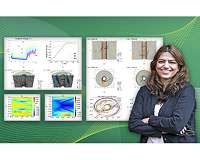
Physicist Fatima Ebrahimi at the U.S. Department of Energy's (DOE) Princeton Plasma Physics Laboratory (PPPL) has for the first time used advanced models to accurately simulate key characteristics of the cyclic behavior of edge-localized modes (ELMs), a particular type of plasma instability.
The findings could help physicists more fully comprehend the behavior of plasma, the hot, charged gas that fuels fusion reactions in doughnut-shaped fusion facilities called tokamaks, and more reliably produce plasmas for fusion reactions. The findings could also provide insight into solar flares, the eruptions of enormous masses of plasma from the surface of the sun into space.
Ebrahimi, who reported the work in May in a paper titled, "Nonlinear reconnecting edge localized modes in current-carrying plasmas" in the journal Physics of Plasmas, achieved the results through nonlinear simulation of the instability. "This research both reproduces and explains the burst-like, or quasi-periodic, behavior of ELMS," said Ebrahimi. "If it occurs in large tokamaks in the future, these bursts could damage some of the machine's internal components. Understanding them could help scientists prevent that damage."
ELMs occur around the outer edge of high-confinement, or H-mode, plasmas due to strong edge currents. Ebrahimi used a computer simulation code known as NIMROD to show how ELMs go through a repeated cycle in which they form, develop, and vanish.
The model demonstrates that ELMs can form when a steep gradient of current exists at the plasma edge. The gradient develops when the plasma moves suddenly up or down, creating a bump in the current and forming an edge current sheet. The instability then forms a current-carrying filament that moves around the tokamak, producing electrical fields that interfere with the currents that caused the ELMs to form. With the original currents disrupted, the ELM dies. "In a way," Ebrahimi said, "an ELM eliminates its own source – erases the bump on the edge current – by its own motion."
Ebrahimi's findings are consistent with observations of cyclic behavior of ELMs in tokamaks around the world. These include Pegasus, a small spherical device at the University of Wisconsin; the Mega Ampere Spherical Tokamak (MAST) in the United Kingdom; and the National Spherical Torus Experiment (NSTX), the flagship facility at PPPL before its recent upgrade.
The research could also improve understanding of solar eruptions, which are accompanied by filamentary structures similar to those produced by ELMs. Her next step will involve investigating the impact of differences in plasma pressure on the cyclic behavior of ELMs.
A quick and easy way to shut down instabilities in fusion devices
Scientists have discovered a remarkably simple way to suppress a common instability that can halt fusion reactions and damage the walls of reactors built to create a "star in a jar." The findings, published in June in the journal Physical Review Letters, stem from experiments performed on the National Spherical Torus Experiment-Upgrade (NSTX-U), at the Department of Energy's Princeton Plasma Phy … read more