
ENERGY TECH
Nanowires could make lithium ion batteries safer
by Staff Writers
Washington DC (SPX) Apr 26, 2018

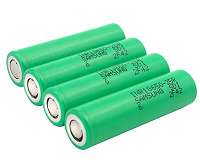
illustration only

From cell phones and laptops to electric vehicles, lithium-ion batteries are the power source that fuels everyday life. But in recent years, they have also drawn attention for catching fire. In an effort to develop a safer battery, scientists report in the ACS journal Nano Letters that the addition of nanowires can not only enhance the battery's fire-resistant capabilities, but also its other properties.

In lithium-ion batteries (LIBs), lithium ions move back and forth between electrodes through an electrolyte. Traditional LIBs have a liquid electrolyte made of salts and organic solvents, but it evaporates easily and can be a fire hazard. So, researchers have turned their attention to solid-state electrolytes as potential alternatives.

Several options have been proposed for solid-state electrolytes, but most are not stable or cannot meet large-scale demands. Polymer electrolytes have shown potential because they are stable, inexpensive and flexible; but they have poor conductivity and mechanical properties.

So, scientists have been adding an array of compounds to enhance the electrolyte. Xinyong Tao and colleagues previously made magnesium borate (Mg2B2O5) nanowires, which had good mechanical properties and conductivity. They wanted to see whether these properties would also be imparted to batteries when these nanowires were added to a solid-state polymer electrolyte.

The team mixed the solid-state electrolyte with 5, 10, 15 and 20 weight percent of the Mg2B2O5 nanowires. They observed that the nanowires increased the conductivity of the electrolytes and allowed them to sustain more stress compared to the electrolyte without nanowires. The increase in conductivity was due to an increase in the number of ions moving through the electrolyte at a faster rate.

The group also tested the flammability of the electrolyte and found that it barely burned. When the nanowire-enhanced electrolyte was paired with a cathode and anode like it would be in a battery, the set-up had a better rate performance and higher cyclic capacity than batteries without added nanowires.

Research paper


Related Links
American Chemical Society
Powering The World in the 21st Century at Energy-Daily.com

ENERGY TECH
Porous salts for fuel cells
London, UK (SPX) Apr 20, 2018
Scientists have developed a new class of crystalline porous organic salts with high proton conductivity for applications such as proton-exchange membranes for fuel cells. As reported in the journal Angewandte Chemie, polar channels that contain water play a critical role in proton conduction. At about 60 C and high humidity, their proton conductivity is one of the best yet found in a porous material. Porous organic materials are potentially useful for many applications, including catalytic system ... read more

Comment using your Disqus, Facebook, Google or Twitter login.

Share this article via these popular social media networks
del.icio.usdel.icio.us DiggDigg RedditReddit GoogleGoogle

ENERGY TECH
Carbon taxes can be both fair and effective, study shows

Trump rolls back Obama-era fuel efficiency rules

Lights out for world landmarks in nod to nature

Puerto Rico power grid snaps, nearly 1 million in the dark

ENERGY TECH
New testing of model improves confidence in the performance of ITER

A higher-energy, safer and longer-lasting zinc battery

Some superconductors can also carry currents of 'spin'

Lockheed delivers 17 MWh of GridStar lithium energy storage to Peak Power

ENERGY TECH
New control strategy helps reap maximum power from wind farms

US renewables firm takes Poland to court over U-turn on windmills

Alberta proposes more renewable energy incentives

Transformer station for giant German wind farm positioned

ENERGY TECH
Organic solar cells reach record efficiency, benchmark for commercialization

Lockheed Martin and Rovsing collaborate to bring solar array simulators to market

Energy conversion: Optical 'overtones' for solar cells

Sea of solar panels turns Mexican desert green

ENERGY TECH
Framatome receives two patent awards for nuclear innovations

Quake hits near Iran nuclear power plant

Namibia president denies graft in nuclear deal

NRC approval brings Framatome's fuel technology closer to market

ENERGY TECH
Wood formation model to fuel progress in bioenergy, paper, new applications

Carbon capture could be a financial opportunity for US biofuels

Research shows how genetics can contribute for advances in 2G ethanol production

Algae-forestry, bioenergy mix could help make CO2 vanish from thin air

ENERGY TECH
Subsea 7 ups ante for McDermott International takeover

Transocean rig continues North Sea tour

Oil prices stuck on now-what questions

Shell holds tight to shale basin in Argentina

ENERGY TECH
Michael Bloomberg pledges $4.5m to Paris climate deal

Trudeau urges nations to make Paris climate deal 'reality'

Unusual climate during Roman times plunged Eurasia into hunger and disease

More frequent droughts mean fewer flowers for bees