
ENERGY TECH
Making new layered superconductors using high entropy alloys
by Staff Writers
Tokyo, Japan (SPX) May 07, 2018

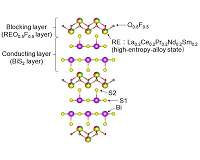
This is a schematic image of the crystal structure of a high-entropy-alloy

Researchers from Tokyo Metropolitan University have created new superconductors made of layers of bismuth sulfide (BiS2) and a high entropy rare earth alloy oxyfluoride, containing five different rare earth (RE) elements at the same crystallographic site.

The new material retains superconducting properties over a wider range of lattice parameters than materials without high-entropy-alloy states. Their work promises an exciting new strategy for designing new layered superconductors, a potentially key development in the search for high-temperature superconductors.

Superconductors are key to a range of exciting potential applications. For example, zero resistivity promises loss-free power transmission and powerful electromagnets. The challenge has been to discover a material that retains this property at higher temperatures, closer to ambient temperatures. Despite focused work and a number of breakthroughs in recent years, the hunt is still on for effective strategies to create new superconducting materials.

One strategy is the use of layered materials with a molecular structure consisting of alternating superconducting layers and "blocking layers" acting as insulating spacers. A team led by Associate Professor Yoshikazu Mizuguchi from the Department of Physics, Tokyo Metropolitan University, has uncovered an important aspect of designing the insulating layer.

They were able to combine five different rare earth (RE) elements, lanthanum, cerium, praseodymium, neodymium, and samarium, and create a "high entropy alloy" in the blocking layer. High entropy alloys have attracted considerable attention in recent years for their toughness, resistance to fatigue and ductility, amongst many other notable physical properties.

The team's new materials, with different proportions of REs (10-30%), exhibited enhanced superconducting properties; in particular, materials with the same period in their molecular structure exhibited a superconducting transition at higher temperatures when the blocking layer contained a high entropy alloy. They believe that the high entropy alloy helps to stabilize the crystal structure of the superconducting layer.

The work's impact is not limited to the new materials they present. Given the existence of a large number of superconducting layers which are compatible with RE oxides, this innovation opens the way for a broad new strategy for engineering new, revolutionary superconducting materials.

Research paper


Related Links
Tokyo Metropolitan University
Powering The World in the 21st Century at Energy-Daily.com

ENERGY TECH
Topological insulator 'flips' for superconductivity
Chicago IL (SPX) May 01, 2018
A groundbreaking sample preparation technique has enabled researchers at the University of Illinois at Urbana-Champaign and the University of Tokyo to perform the most controlled and sensitive study to date of a topological insulator (TI) closely coupled to a superconductor (SC). The scientists observed the superconducting proximity effect - induced superconductivity in the TI due to its proximity to the SC - and measured its relationship to temperature and the thickness of the TI. TIs with induce ... read more

Comment using your Disqus, Facebook, Google or Twitter login.

Share this article via these popular social media networks
del.icio.usdel.icio.us DiggDigg RedditReddit GoogleGoogle

ENERGY TECH
Carbon taxes can be both fair and effective, study shows

Trump rolls back Obama-era fuel efficiency rules

Lights out for world landmarks in nod to nature

Puerto Rico power grid snaps, nearly 1 million in the dark

ENERGY TECH
Antimatter study to benefit from recipe for ten-fold spatial compression of plasma

Water-based battery can store solar and wind energy

Chemists develop MRI-like technique to detect what ails batteries

A novel voltage peak in the metal nanowire-superconductor hybrid structure

ENERGY TECH
US renewables firm takes Poland to court over U-turn on windmills

New control strategy helps reap maximum power from wind farms

Alberta proposes more renewable energy incentives

Transformer station for giant German wind farm positioned

ENERGY TECH
Bright future for solar cell technology

Renewable energy use accelerating, but progress is lacking

Harnessing synergies between solar energy, heat and mobility

Harvesting clean hydrogen fuel through artificial photosynthesis

ENERGY TECH
Demonstration proves nuclear fission system can provide space exploration power

Framatome and Vattenfall sign contracts for the delivery of fuel assembly reloads

Balancing nuclear and renewable energy

Framatome receives two patent awards for nuclear innovations

ENERGY TECH
Solar powered sea slugs shed light on search for perpetual green energy

Novel approach for photosynthetic production of carbon neutral biofuel from green algae

Energy recovery of urban waste

Novel reaction could spark alternate approach to ammonia production

ENERGY TECH
Oil prices move higher amid Iran deal uncertainty, low U.S. unemployment

DR Congo planning to allow oil exploration in national parks: NGO

Oil prices drop on higher U.S. crude stockpiles, record production

Canada oil sector faces 'significant challenges' to reduce emissions

ENERGY TECH
Dramatic action needed on climate change: UN

Scientists project a drier Amazon and wetter Indonesia in the future

Saskatchewan province goes to court to fight Canada carbon tax

In southern Iraq, drought tightens its grip