
ENERGY TECH
Juelich researchers are developing fast-charging solid-state batteries
by Staff Writers
Juelich, Germany (SPX) Aug 22, 2018

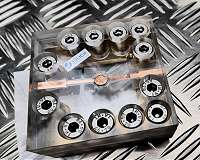
Test set-up for the solid-state battery: the battery of the size of a button cell is located in the middle of the acrylic glass casing, which ensures permanent contact with the battery.

The low current is considered one of the biggest hurdles in the development of solid-state batteries. It is the reason why the batteries take a relatively long time to charge. It usually takes about 10 to 12 hours for a solid-state battery to fully charge. The new cell type that Julich scientists have designed, however, takes less than an hour to recharge.

"With the concepts described to date, only very small charge and discharge currents were possible due to problems at the internal solid-state interfaces. This is where our concept based on a favourable combination of materials comes into play, and we have already patented it," explains Dr. Hermann Tempel, group leader at the Juelich Institute for Energy and Climate Research (IEK-9).

In conventional lithium-ion batteries, a liquid electrolyte is used, which usually contacts the electrodes very well. With their textured surfaces, the electrodes soak up the liquid like a sponge, creating a large contact area. In principle, two solids cannot be joined together seamlessly. The contact resistance between the electrodes and the electrolyte is correspondingly high.

"In order to allow the largest possible flow of current across the layer boundaries, we used very similar materials to produce all components. The anode, cathode, and electrolyte were all made from different phosphate compounds to enable charging rates greater than 3C (at a capacity of about 50 mAh/g). This is ten times higher than the values otherwise found in the literature," explains Hermann Tempel.

The solid electrolyte serves as a stable carrier material to which phosphate electrodes are applied on both sides using the screen printing process. The materials used are reasonably priced and relatively easy to process. Unlike conventional lithium-ion batteries, the new solid-state battery is also largely free of toxic or harmful substances.

"In initial tests, the new battery cell was very stable over 500 charge and discharge cycles and retained over 84 percent of its original capacity," said Dr. Shicheng Yu. "There is still room for improvement here. Theoretically, a capacity loss of less than 1 percent should even be feasible," said Yu, who developed and tested the battery as part of a China Scholarship Council (CSC) funding programme at the Julich Institute for Energy and Climate Research (IEK-9).

Institute director Prof. Ruediger-A. Eichel is also convinced of the advantages of the new battery concept. "The energy density is already very high at around 120 mAh/g, even if it is still slightly below that of today's lithium-ion batteries," says Eichel.

In addition to the development for electromobility, the spokesman for the "battery storage" topic in the Helmholtz Association believes solid-state batteries will also be used in other areas in future: "Solid-state batteries are currently being developed with priority as energy storage for next-generation electric vehicles. But we also believe that solid-state batteries will prevail in other fields of application that require a long service life and safe operation, such as medical technology or integrated components in the smart home area," says Eichel.

Research Report: "Monolithic All-Phosphate Solid-State Lithium-Ion Battery with Improved Interfacial Compatibility"


Related Links
Forschungszentrum Juelich
Powering The World in the 21st Century at Energy-Daily.com

ENERGY TECH
Doubling performance with lithium metal that doesn't catch fire
Ann Arbor MI (SPX) Aug 17, 2018
- A rechargeable battery technology developed at the University of Michigan could double the output of today's lithium ion cells - drastically extending electric vehicle ranges and time between cell phone charges - without taking up any added space. By using a ceramic, solid-state electrolyte, engineers can harness the power of lithium metal batteries without the historic issues of poor durability and short-circuiting. The result is a roadmap to what could be the next generation of rechargeable b ... read more

Comment using your Disqus, Facebook, Google or Twitter login.

Share this article via these popular social media networks
del.icio.usdel.icio.us DiggDigg RedditReddit GoogleGoogle

ENERGY TECH
Electricity crisis leaves Iraqis gasping for cool air

Energy-intensive Bitcoin transactions pose a growing environmental threat

Germany thwarts China by taking stake in 50Hertz power firm

Global quadrupling of cooling appliances to 14 billion by 2050

ENERGY TECH
Scientists turn to the quantum realm to improve energy transportation

A paper battery powered by bacteria

Doubling performance with lithium metal that doesn't catch fire

Advanced plasma switch for more efficient transmission

ENERGY TECH
Denmark gets nod for renewable energy support scheme

Searching for wind for the future

Clock starts for Germany's next wind farm

ENGIE: Wind energy footprint firmed up in Norway

ENERGY TECH
Constellation begins construction on 10MW solar array in Maryland

Sanjeev Gupta to build 280MW solar farm in South Australia

Brown selects Freedom Solar Power to design and install rooftop solar array

China lodges WTO complaint on U.S. solar tariffs

ENERGY TECH
Extreme makeover: Fukushima nuclear plant tries image overhaul

Framatome becomes main distributor of Chesterton valve packing and seals for the nuclear energy industry

SUSI submarine robot enables successful visual Inspection at Asco Nuclear Power Plant

EDF sees new delay, cost overruns for nuclear reactor

ENERGY TECH
Ethiopia opens plant to turn waste into energy

Thermal switch discovered in engineered squid-based biomaterials

Trees and climate change: Faster growth, lighter wood

Renewables could drastically cut tailpipe emissions

ENERGY TECH
US condemns Venezuela 'arbitrary' arrests over alleged attack

World's biggest shipper to spin off Maersk Drilling

Australian minister pushes for offshore development

New cash will fund Canadian shale operations

ENERGY TECH
Next half-decade will be hotter than expected, climate scientists predict

Australia ramps up aid to farmers as drought bites

Leadership fears see Australia PM back away from climate targets

Britain's dry summer reveals ancient sites