Ionic transport has been studied extensively over the years for energy devices such as fuel cells and batteries using Li+, H+, Ag+, Cu+, F-, and O2-. Yet as Genki Kobayashi and Ryoji Kanno point out in a recent report, hydride ions (H-) may be particularly useful for high-energy-density storage and conversion devices. Using an oxyhydride solid state cell they have now demonstrated pure H- conduction in an oxide for the first time.
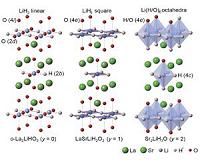
Metal hydrides tend to have an inflexible lattice, which makes H- transport difficult, so the researchers turned to oxyhydrides where oxygen and hydrogen share the same lattice sites.
Another challenge is the high electron-donating properties of H-, which means that the electrons will dissociate from the H- to produce protons and electrons, giving rise to electron rather than hydride-ion transport. As a result the team sought a system containing cations that were more electron-donating than the H-.
Kobayashi and Kanno collaborated with colleagues from the Institute for Molecular Science, Japan Science and Technology Agency, Tokyo Institute of Technology, Kyoto University and High Energy Accelerator Research Organization in Japan.
They examined how the structure of their oxyhydride compounds changed with composition and synthesis conditions . They also studied characteristics of the electronic structure that suggested an ionic Li-H bond in the compound, namely the existence of H- in the oxides.
They then used La2LiHO3 in an orthorhombic structural phase (o- La2LiHO3) as an electrolyte in a cell with titanium anode and titanium hydride cathodes. Phase changes at the electrodes by the discharge were consistent with a Ti-H phase diagram suggesting hydride-ion transport.
They conclude: "The present success in the construction of an all-solid-state electrochemical cell exhibiting H- diffusion confirms not only the capability of the oxyhydride to act as an H- solid electrolyte but also the possibility of developing electrochemical solid devices based on H- conduction."