
ENERGY TECH
Demonstration of a single molecule piezoelectric effect
by Staff Writers
Prague, Czech (SPX) Feb 16, 2018

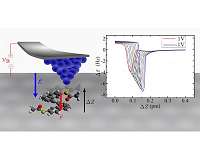
The converse piezoelectric effect in single heptahelicene-derived molecules.

Researchers from the Institute of Organic Chemistry and Biochemistry of the CAS (IOCB Prague), Institute of Physics of the CAS (IP CAS) and Palacky University Olomouc demonstrated for the first time a single molecule piezoelectric effect.

The study published in the Journal of the American Chemical Society represents a breakthrough in understanding the electromechanical behavior of individual molecules and provides a new concept of the design of molecular motors, sensors and electricity generators at nanoscale.

The piezoelectric effect emerges in some materials in which the mechanical and electrical properties are coupled. Either the electric field can be generated if a mechanical stress is applied (direct piezoelectric effect) or, conversely, the mechanical deformation can arise if the electric field is applied (converse piezoelectric effect).

These effects have reached numerous practical applications in automotive, smartphone, computer, medical and military industries. In our everyday life, we meet the piezoelectric effect in smartphones, microphones or lighters, it is also widely employed in airbag systems, sonars or scanning microscopes.

Possible applications of the piezoelectric effect to nanotechnology are currently under the spotlight and intensively studied. However, the single molecule piezoelectric effect, which is essential for envisioned electromechanical molecular devices, has so far remained elusive.

"In a close collaboration with physicists, it was proved for the first time that a strong converse piezoelectric effect can be observed at individual molecules of the heptahelicene derivative, which is a screw-like carbon molecule resembling a spring," said Ivo Stary, the leader of the group of chemists at IOCB Prague preparing the compound.

The effect was experimentally demonstrated by the group of physicists at IP CAS at individual molecules on a silver surface using scanning probe microscopy. The group leader Pavel Jelinek explains: "The magnitude of the piezoelectric constant calculated from the experimental data is significantly higher than that one of known piezoelectric polymers and is comparable to the magnitudes measured at some inorganic materials such as zinc oxide. Moreover, we explained the origin of the single molecule piezoelectric effect by employing quantum mechanics calculations."

How does the converse piezoelectric effect work at nanoscale? The screw-like molecule endowed with an inner dipole stretches or squeezes itself depending on the strength and polarity of the outer electric field. It arises by applying a voltage bias between the silver pad and atomically sharp tip of the scanning microscope that resides over the studied molecule.

As the change in a molecule height can be monitored with an ultimate accuracy, it is possible to see a molecule deformation induced by the electric field. Such a coupling of the mechanical movement of a molecule and the change in electric field, which is reciprocal by theory, represents an entry into the world of molecules doing mechanical work on one hand and molecular nanogenerators of electric energy on the other hand.

Research Report: Large Converse Piezoelectric Effect Measured on a Single Molecule on a Metallic Surface


Related Links
Institute of Organic Chemistry and Biochemistry of the Czech Academy of Sciences (IOCB Prague)
Powering The World in the 21st Century at Energy-Daily.com

ENERGY TECH
UNIST researchers develop highly stretchable aqueous batteries
Ulsan, South Korea (SPX) Feb 13, 2018
The current development of stretchable battery materials that mimic the functions of nature has emerged as a highly interesting research area, necessary for the next wave of wearable electronics. A recent study, affiliated with UNIST has presented a bioinspired Jabuticaba-like hybrid carbon/polymer (HCP) composite that was developed into a stretchable current collector using a simple and cost-effective solution process. Using the HCP composite as a stretchable current collector, the research team ... read more

Comment using your Disqus, Facebook, Google or Twitter login.

Share this article via these popular social media networks
del.icio.usdel.icio.us DiggDigg RedditReddit GoogleGoogle

ENERGY TECH
Coal phase-out: Announcing CO2-pricing triggers divestment

State utilities called to pass U.S. tax benefits to consumers

Magnetic liquids improve energy efficiency of buildings

US energy watchdog rejects plan to subsidize coal, nuclear sectors

ENERGY TECH
UNIST researchers develop highly stretchable aqueous batteries

Powerful LED-based train headlight optimized for energy savings

System draws power from daily temperature swings

Recycling and reusing worn cathodes to make new lithium ion batteries

ENERGY TECH
Ireland pushing for greener economy

China wind turbine-maker guilty of stealing US trade secrets

Scotland sets up $83 million low-carbon fund

German offshore wind farm closer to powering mainland

ENERGY TECH
China's Solar-Powered Drone Test-Fires Missiles in Near Space

Cost-reduction roadmap outlines two pathways to meet DOE residential solar cost target for 2030

Researchers discover new lead-free perovskite material for solar cells

Avoiding blackouts with 100 percent renewable energy

ENERGY TECH
Toshiba tips return to black as it sells chip, nuclear units

Turkey's first nuclear power plant set for investor shake-up: reports

Thorium reactors may dispose of enormous amounts of weapons-grade plutonium

Framatome continues ramping up production at its Le Creusot site

ENERGY TECH
Biochar could replace unsustainable peat moss in greenhouse industry

Argonne and Energy Vision demonstrate Renewable Natural Gas as transport fuel

Lithuanian researchers: Wastewater treatment plants could generate electricity

Calculating the CO2 emissions of biofuels is not enough

ENERGY TECH
U.S. oil supply growth pressures oil prices

UN envoy sees possible South Sudan deal from talks in Ethiopia

IEA: U.S. oil production, exports means shift in trade patterns

Egyptian gas momentum picks up with Atoll, Zohr fields

ENERGY TECH
US intel chief issues warning about climate change

Extreme weather to rise even if Paris goals are met: study

Key to predicting climate change could be blowing in the wind, researchers find

Research identifies 'evolutionary rescue' areas for animals threatened by climate change