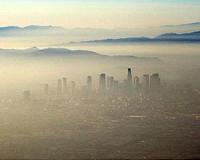
Tim Krantz still remembers a time when the pollution in Los Angeles was so bad it turned the sky yellow, making it hard to breathe and irritating the eyes.
Today, the skies over the city are clear enough to see the Pacific Ocean from the Hollywood hills or the San Gabriel Mountains to the north.
But the skies didn't clear overnight.
"I know how bad it used to be in the 1970s, you didn't see the mountains for months," said Krantz, a professor of environmental studies at the University of Redlands in California.
Faced with a critical situation, state authorities were given carte blanche to come up with some of the boldest ever environmental laws — which formed the basis for national efforts to combat pollution.
While California still has significant environmental problems, experts say there is no denying the state has adopted some of the world's toughest air quality standards, setting it at the forefront of the battle on climate change.
One of the most significant steps came in 2006 when then governor Arnold Schwarzenegger signed legislation requiring industries to reduce all greenhouse gas emissions by 25 percent over 13 years.
Current governor Jerry Brown further boosted the state's climate change goals last month with ambitious legislation that aims for California to generate 50 percent of its electricity from renewable resources such as wind and solar energy by 2030.
It also calls for buildings in the West Coast state of nearly 40 million people to become twice as energy efficient by that date.
– 'Existential threat' –
On the recycling front, Brown is pushing forth with a plan to have 75 percent of all waste recycled by 2020.
The 77-year-old governor, who will be attending the climate summit in Paris later this month, has taken his climate crusade worldwide, even discussing it with Pope Francis this summer.
"It's time we acknowledge that a changing climate poses the same existential threat to life on this planet as the current nuclear arms race," Brown told a science conference this month.
But though often touted as the greenest government official in America, Brown recently was seen as bowing to oil companies when he refused to back an outright ban on hydraulic fracturing, also known as fracking, a controversial oil extraction technique that uses huge amounts of water.
He has defended his decision on grounds that the state heavily relies on oil and an outright ban would be unwise at this time.
California has some 30 million vehicles and since 2000 has put in place financial incentives to boost the sale of electric cars. Every parking lot or area is also required by law to designate spots with charging units.
The state today accounts for nearly half of all electric cars sold across the country.
– Not crying victory –
Officials are not yet crying victory.
The Los Angeles metropolitan area still has some of the most polluted air in the country and the state is experiencing a historic drought that has forced severe water cutbacks.
Massive fires this summer have scarred vast swathes of southern California's landscape, raising concerns over the environmental impact.
"The number one issue of concern in California is the drought," said Debbie Raphael, head of the San Francisco Department of Environment, adding that now was the time to implement sound changes, notably in water management.
"There is very little oversight of ground water, our water rights system is over 100 years old and inadequate, people are still allowed to use large amounts of water because it is still cheap," Raphael said.
Convincing Californians to turn down the air conditioning — used to pump glacial air into their homes and offices in the desert heat — will be no easy feat.
But despite the challenges still ahead, experts say there is no denying California's role in combating climate change.
"California is showing how a carbon market can work, how greenhouse gas emissions reductions can work," said Stephanie Pincetl, a professor of environmental studies at UCLA's California Center for Sustainable Communities.
"These are huge commitments and California has become a leader and example."